Protecting a commercial building from fire involves considerably more than installing sprinkler heads throughout the ceiling. Every business presents its own combination of people, property, equipment, building configuration, combustible materials, and operational risks. A system appropriate for a small professional office may be entirely different from one protecting a large warehouse, retail store, manufacturing facility, restaurant, or multi tenant commercial property.
Commercial Fire Protection Demands Specialized Experience
Our commercial fire sprinkler services in New Jersey are built around one fundamental principle: fire protection must correspond to the actual property and the hazards within it. Commercial sprinkler protection requires careful planning, knowledgeable installation, professional inspection, testing, maintenance, and responsive repairs.
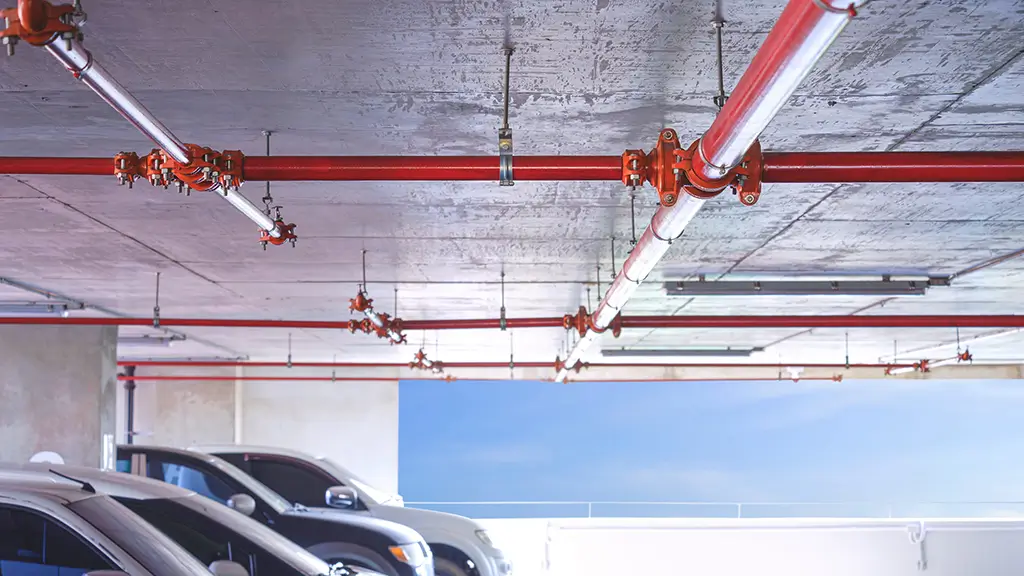
Don’t Take Chances!
Commercial Fire Sprinklers Require Real Expertise.
Most importantly, it requires experience. The consequences of overlooking a seemingly small detail can extend far beyond property damage when employees, customers, tenants, inventory, equipment, and business continuity are involved.
Commercial and Residential Fire Sprinklers Serve Different Environments
Residential and commercial sprinkler systems share the same fundamental objective of controlling fire, but the environments they protect can be dramatically different. Residential systems are primarily designed around life safety within living environments. Commercial buildings introduce a much broader range of occupancies and potential hazards. An office contains electronics, furnishings, employees, and records. A retail store adds customers, inventory, displays, storage areas, and constantly changing merchandise. Warehouses may contain tall storage racks and significant quantities of combustible products.
Manufacturing facilities can introduce machinery, production processes, specialized materials, and potentially more challenging fire hazards. These differences influence how commercial sprinkler protection is evaluated and designed. Water demand, sprinkler type, spacing, piping, available water supply, hazard classification, storage configuration, and other factors may all require careful consideration. Commercial fire protection therefore cannot be approached as simply a larger version of residential fire protection.
The Business Inside the Building Matters
One of the most important concepts in commercial fire sprinkler protection is that square footage alone does not define risk. Two buildings of similar size can require very different fire protection strategies because of what happens inside them.
Consider the difference between an accounting office and an auto repair facility. Both might occupy similar commercial spaces, but their contents, equipment, operations, and potential fire conditions are very different. The same principle applies when comparing a clothing retailer with a furniture showroom or a conventional warehouse with a facility containing tall rack storage. Experienced commercial fire protection professionals examine the building in context. How is the space used? What is stored there? How high is it stored? How many people occupy the property? Are there specialized hazards? Has the business changed since the sprinkler system was originally designed?
Those questions can be just as important as the dimensions of the building itself.
New Jersey Commercial Sprinkler Requirements Can Depend on Occupancy
New Jersey’s building and fire safety framework recognizes that different occupancies create different levels and types of risk. Commercial properties may fall within classifications involving assembly, business, factory, mercantile, storage, institutional, residential, or other uses. Sprinkler requirements can depend on factors such as occupancy classification, fire area, occupant load, building height, storage arrangements, and location within the structure.
This means there isn’t one universal rule stating that every commercial building receives the same sprinkler system. A restaurant accommodating a substantial number of guests, for example, raises different considerations from a small office. A retail property with extensive merchandise storage presents different challenges from a professional services building. Understanding these distinctions is one reason experienced commercial fire sprinkler professionals are so valuable. The objective isn’t merely to install equipment. It’s to understand the property, applicable requirements, and protection strategy as a complete system.
A Little Known New Jersey Detail About High Piled Storage
Here’s a commercial fire safety issue that many New Jersey business owners may never consider: changing the way merchandise is stored can potentially change the fire protection equation even when the building itself hasn’t changed. Warehouses and certain retail operations frequently evolve. Businesses add taller racks, increase inventory, change packaging materials, or reorganize storage to maximize available space.
Those seemingly ordinary operational decisions can matter tremendously to fire protection. High piled and rack storage can introduce specific fire safety considerations because fire can spread vertically through stored commodities differently than it does across ordinary floor level contents. The height, arrangement, and type of stored materials can therefore become important factors in determining appropriate protection. This illustrates an important lesson for commercial property owners: sprinkler protection isn’t necessarily static. When the hazards inside a building change significantly, the suitability of the existing protection may deserve another look.
Water Demand Becomes Critical in Commercial Properties
Commercial sprinkler systems can require substantial quantities of water delivered at appropriate pressures. This is where fire protection engineering becomes particularly important. A commercial system must account for the available water supply and the hydraulic demands created by the building and its hazard characteristics. Depending on those conditions, equipment such as fire pumps, storage tanks, backflow assemblies, or other components may become part of the overall fire protection strategy.
A system containing hundreds or thousands of sprinkler heads isn’t designed around the assumption that every sprinkler operates simultaneously. Instead, hydraulic calculations evaluate defined operating scenarios according to applicable design criteria. That balance requires precision. Too little available water can compromise protection, while unnecessarily excessive system requirements can create avoidable complexity and expense. Experienced design allows safety and efficiency to work together.
Commercial Buildings Constantly Change
One of the greatest challenges in commercial fire protection is that businesses evolve much faster than buildings do. A warehouse adds racks. A retailer changes displays. An office renovates its floor plan. A restaurant expands. A manufacturing company introduces new machinery. A building owner divides a large suite into several tenant spaces. Each change can potentially affect sprinkler coverage, obstructions, hazard conditions, or system configuration.
A sprinkler system originally designed for an open ceiling may need evaluation after new walls or ceilings are installed. Tall shelving may interfere with sprinkler discharge. New equipment can create obstructions. A change in occupancy may introduce a completely different fire hazard. That’s why experienced commercial sprinkler service should involve understanding the building as it exists today, not simply relying on what appears on an old set of plans.
Mixed Use New Jersey Properties Can Become Particularly Complex
New Jersey contains countless older downtown buildings, mixed use properties, converted industrial structures, and buildings that have been renovated repeatedly over many decades. These properties can create fascinating fire protection challenges. A single structure might contain retail space on the first floor, offices above, storage in another area, and residential units on upper floors. Different uses within one building can introduce different code and protection considerations.
New Jersey’s Rehabilitation Subcode also creates a framework specifically addressing work performed in existing buildings. Depending on the scope and classification of the work, sprinkler requirements can become relevant during substantial rehabilitation. One lesser known example demonstrates how forward looking these requirements can be: under certain New Jersey rehabilitation provisions for particular institutional occupancies, when sprinkler installation is triggered in a substantial work area, the sprinkler riser may need to be sized to accommodate the entire building even when only part of the building is initially being sprinklered.
That is precisely the kind of detail that demonstrates why New Jersey commercial fire protection benefits from professionals familiar with the state’s regulatory environment.
Commercial Sprinkler Systems Protect More Than the Building
When discussing commercial fire protection, it’s easy to focus exclusively on the physical structure. But businesses contain much more than walls and ceilings. A sprinkler system may be protecting expensive machinery, inventory, computers, customer records, specialized tools, production lines, furnishings, and years of business investment. More importantly, it protects employees, customers, contractors, and visitors.
Then there is business continuity.
A serious fire can interrupt operations for weeks or months. Even when insurance eventually covers portions of the physical loss, businesses can still face lost customers, production delays, disrupted supply chains, employee displacement, and damaged relationships. Effective sprinkler protection is therefore not simply a building expense. It is part of protecting the organization’s ability to survive an unexpected event.
Inspection, Testing and Maintenance Matter After Installation
Commercial sprinkler responsibility doesn’t end when installation is complete. Businesses change, equipment ages, valves can be disturbed, sprinkler heads can become damaged, piping can corrode, and environmental conditions can affect system components. Regular professional inspection, testing, and maintenance help identify these concerns before they become more serious. Commercial properties can also contain multiple interconnected fire protection components. Sprinkler systems may interact with alarm equipment, fire pumps, supervisory devices, standpipes, and other systems depending on the building.
Documentation becomes important as well. Building owners and facility managers benefit from maintaining organized records of inspections, testing, maintenance, repairs, and system changes. A well managed fire protection program creates continuity even when property managers, employees, or tenants change.
Experience Matters When Regulations and Business Needs Meet
Commercial fire protection exists at the intersection of engineering, construction, fire safety, regulation, and business operations. That’s what makes experience so valuable. A knowledgeable sprinkler contractor must understand technical requirements while also appreciating practical realities. Businesses have operating schedules. Warehouses need access to inventory. Retailers have customers. Manufacturers have production demands. Property managers coordinate multiple tenants.
Fire protection work needs to be performed correctly without losing sight of how the building actually functions. The best solutions don’t treat safety and business operations as competing priorities. They intelligently coordinate both.
Why Choose Armor Automatic Sprinkler for Commercial Fire Sprinklers in NJ?
Armor Automatic Sprinkler has been protecting commercial properties throughout New Jersey and the New York metropolitan area for decades. Our experience extends across the complete lifecycle of fire sprinkler systems, including engineering and design, installation, inspection, testing, maintenance, repair, and emergency service. That comprehensive experience matters in commercial environments because sprinkler systems don’t exist in isolation. A design decision affects installation. Installation quality influences long term reliability. Inspections identify deficiencies. Maintenance preserves equipment, and repairs restore protection when problems occur.
Our team understands that commercial customers need more than technical expertise. They need responsive communication, dependable scheduling, knowledgeable professionals, and solutions appropriate for their particular properties.
Whether you’re protecting an office, retail property, warehouse, manufacturing operation, mixed use building, or another commercial facility, we approach every project with the seriousness that life safety deserves.
Protect Your New Jersey Business With Experienced Fire Protection
Your commercial property represents an investment in people, equipment, inventory, productivity, and the future of your business. Fire protection deserves the same careful planning and professional attention as every other critical building system. If you’re planning a new commercial sprinkler system, evaluating an existing system, renovating a property, changing building use, expanding storage, or simply looking for an experienced fire protection partner, we’re ready to help.
Contact Us Today to discuss your commercial fire sprinkler needs in New Jersey. Our experienced team can help you understand your property’s fire protection requirements and develop a solution designed around safety, reliability, and the unique demands of your business.