You own a 1920s three-story brick building in Paterson. Twelve apartments over a storefront. You’re planning a gut renovation of the upper floors, and the architect just told you the plans will need a sprinkler system. Now you need a contractor. And you’ve never hired one for this before.
Get this one right. A sprinkler contractor isn’t someone you replace easily once the pipe is in the ceiling.
To choose a qualified fire sprinkler contractor for a New Jersey apartment building, check four things. First, state credentials: New Jersey certifies fire sprinkler contractors, and you can ask for the certification and license numbers.
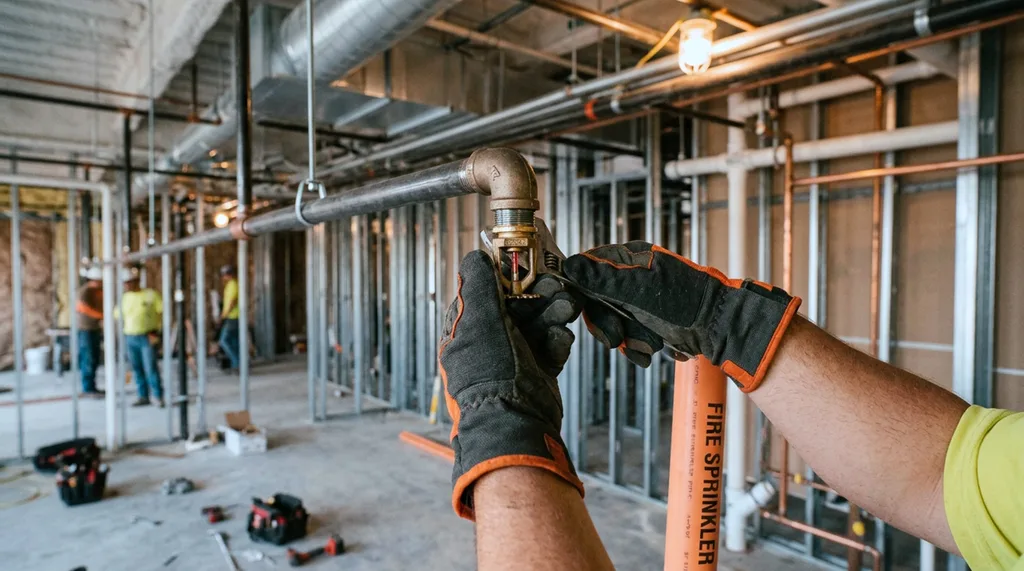
Fire Sprinklers In NJ Apartment Buildings
Second, design capability, because installation only works when it follows a proper design for your building type, often under NFPA 13R or NFPA 13. Third, experience in occupied residential buildings, where tenants live through the work. Fourth, what happens after installation: testing, documentation, inspections and service. A contractor who handles design through maintenance is easier to work with than three separate vendors.
Contractor checklist
| Check | Why |
| NJ certification and license | The state certifies fire sprinkler contractors |
| Design in-house or coordinated | Installation has to follow a proper design |
| Knows NFPA 13R vs NFPA 13 | The right standard depends on the building |
| Apartment experience | Working around tenants takes planning |
| Testing and documentation | Proves the system works before sign-off |
| Inspection and service after | Systems need ongoing inspection and testing |
| Emergency service | Leaks and damage don’t wait for Monday |
Credentials come first
New Jersey doesn’t leave this to chance. The state’s administrative code sets certification requirements for fire protection equipment contractors. For a Fire Sprinkler System Contractor, it requires a valid NICET Level II certification in inspection and testing of water-based systems, plus passing the Level 1 exam in water-based fire protection system layout. NICET is the National Institute for Certification in Engineering Technologies.
So ask. Who in your company holds the certification? What’s your license number? Then check it.
Armor holds Master Fire License #P00486 and is a licensed fire protection equipment and suppression contractor in New Jersey.
Design before pipe
A good sprinkler system starts on paper. Proper installation only begins after a professional design has been done. Then the installer still has to check for conflicts with ceiling obstructions, light fixtures and ventilation before they turn into problems on site.
Ask whether the contractor designs in-house or coordinates closely with whoever does. See our Fire Sprinkler Design page.
NFPA 13R or NFPA 13?
Apartment buildings often fall under one of two standards. The National Fire Sprinkler Association explains that NFPA 13R covers residential occupancies like apartments and hotels, while NFPA 13 covers all occupancies. Under 13R, certain lower-risk areas, like attics, porches, small closets, small bathrooms and crawl spaces, may be exempt.
There’s a size limit, though. Per the NFSA, the 2021 International Building Code limits 13R systems to buildings of four stories or fewer above the grade plane, with height limits measured from fire department access. The 2024 code raised one of those limits for certain apartment buildings.
Bigger building, or a mixed-use building with retail on the ground floor? The answer may change. That’s exactly why you want a contractor who knows both standards and can explain which one applies to you, and why.
Renovating an older building
Most apartment buildings in North and Central Jersey aren’t new. When you renovate, alter, add on or change how a building is used, New Jersey’s Rehabilitation Subcode sets the requirements. Older buildings bring their own headaches: plaster ceilings, tight joist spaces, unheated stairwells and basements that need freeze protection.
That last one matters. Wet pipe systems only work where pipe stays above freezing. For unheated spaces, dry pipe systems using pressurized air or nitrogen are an option. A contractor should spot those areas during design, not after a pipe bursts in January.
Working around tenants
If the building’s occupied, ask how the contractor handles it. In occupied buildings, work often has to be scheduled to limit disruption. Tenants need notice. Access to units has to be planned. Dust and debris have to be controlled. Ask for a rough schedule floor by floor.
Testing and documentation
Before the system is signed off, it gets tested. That can include hydrostatic pressure testing, flushing, alarm interface verification and operational testing. Inspections and paperwork confirm the system meets requirements. Ask what documentation you’ll get at the end. Your insurer and your fire official may both ask for it.
Installation is only the start
A sprinkler system needs ongoing inspection and testing for as long as it’s in the building. Read How Often Should Fire Sprinkler Systems Be Inspected and Tested? And know what inspectors write up most, from Common Fire Sprinkler System Deficiencies That Can Cause a Failed Inspection.
We handle Fire Sprinkler Inspection, Fire Sprinkler Maintenance and Fire Sprinkler Repair, plus 24 hour service for emergencies.
Frequently Asked Questions
What certification does a NJ fire sprinkler contractor need?
New Jersey requires a Fire Sprinkler System Contractor to hold NICET Level II certification in inspection and testing of water-based systems and pass the Level 1 layout exam.
What is the difference between NFPA 13R and NFPA 13?
NFPA 13R covers residential occupancies like apartments and hotels, with some low-risk areas exempt. NFPA 13 covers all occupancies.
Can NFPA 13R be used in any apartment building?
No. Under the 2021 International Building Code, 13R is limited to buildings of four stories or fewer above grade plane, with height limits.
What testing happens after sprinkler installation?
Testing can include hydrostatic pressure testing, flushing, alarm interface verification and operational testing.
Planning sprinklers for an apartment building? Armor Automatic Sprinkler has more than 40 years of experience in fire protection and is based on River Road in Clifton. Call 800-778-3473, see our Fire Sprinkler Installation page, read our Reviews, or contact us.